
The Supreme Court's Tariff Ruling
A defining moment for monetary policy and market expectation
Tariff Authority Significantly Narrowed

On February 20th, the Supreme Court ruled on the legality of tariffs imposed under the International Emergency Economic Powers Act (“IEEPA”). In a 6–3 decision, the Court concluded that the President’s use of IEEPA to impose broad-based tariffs exceeded the authority granted by Congress. Practically speaking, this invalidates the majority of tariffs implemented under the most recent round of trade actions — including a significant portion of the so-called “reciprocal tariffs” applied to Europe, Japan, Vietnam, India, and roughly 65 other countries, as well as the incremental tariffs layered onto China beyond earlier measures.
This is not a technical adjustment. It alters the legal foundation for more than 60% of recent tariff actions and reduces the average effective tariff rate on U.S. imports by an estimated eight percentage points — from roughly 13% to closer to 5% — assuming full implementation of the ruling. For investors, the key question is not the legal nuance, but how this reshapes the trade framework going forward.
What the Court Changed
IEEPA was originally designed to give the executive branch flexibility to respond to national emergencies, particularly financial or geopolitical threats. It was not structured as a general trade policy instrument. The Court determined that IEEPA does not authorize across-the-board tariffs of the scale imposed. As a result, the following measures are invalidated:
The reciprocal tariffs applied to approximately 65 countries, including 15% on Europe and Japan, 20% on Vietnam, and 18% on India.
The 25% tariffs on non-USMCA compliant goods from Canada and Mexico.
The additional 30% tariffs imposed on China under IEEPA authority, separate from prior China tariffs.
Collectively, these measures represented the majority of recent tariff escalation. The ruling therefore meaningfully narrows the scope of executive trade authority under emergency statutes.
What Remains in Place
Importantly, this is not a return to a tariff-free environment. The ruling does not affect tariffs imposed under other statutes. Most notably, tariffs under Section 232 of the Trade Expansion Act of 1962 remain intact:
25% on steel
10% on aluminum
25% on autos and auto parts, with certain carve-outs
25% on copper and lumber
50% on selected semiconductors
Section 232 explicitly addresses national security concerns, and courts have historically afforded the executive broad discretion in this area. The Section 301 tariffs on China from 2018–2019 also remain in force at approximately 20%.
In short, the U.S. remains structurally more protectionist than it was pre-2018. The ruling narrows the toolkit but does not unwind the broader strategic shift toward selective protectionism.
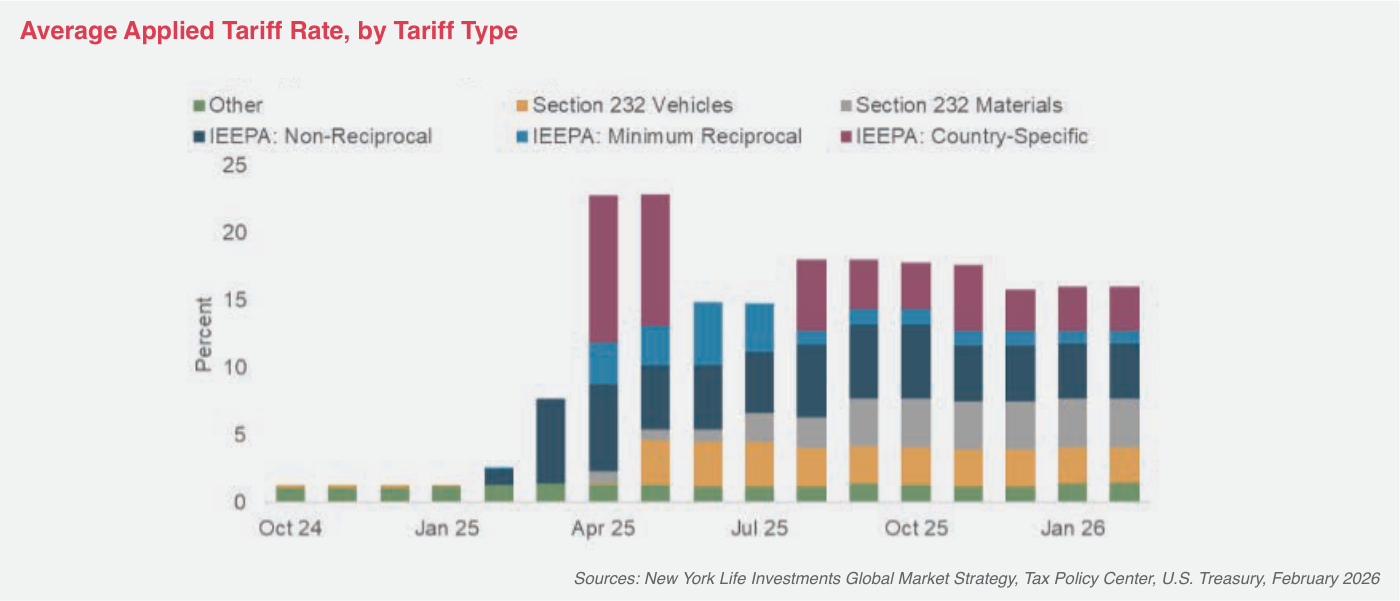
Sources: New York Life Investments Global Market Strategy, Tax Policy Center, U.S. Treasury, February 2026
The Administration’s Next Steps
The President indicated (almost within an hour of the ruling) that alternative statutory authorities will be used to pursue further tariff measures. Two mechanisms are central:
Section 122 of the Trade Act, which allows a temporary 10% tariff in cases of balance-of-payments concerns. It is limited to five months unless Congress approves an extension, and is aimed primarily at trade deficit countries.
Section 301 investigations, which require formal findings of unfair trade practices and involve a structured review process.
These tools are more constrained procedurally and politically. Congress intentionally embedded those limitations decades ago to ensure oversight and prevent unilateral, open-ended trade actions. For markets, this suggests future tariff changes are likely to be more incremental, legally structured, and time-bound.
Fiscal Considerations: The Refund Issue
An important secondary implication is fiscal. To date, approximately $175 billion in tariff revenue has been collected under IEEPA authority. If those collections are ultimately deemed unlawful and subject to refund, the government may need to return those funds to importers. For context, the current fiscal year deficit is approximately $1.7 trillion. A full refund of $175 billion would increase the deficit meaningfully, though still within the broader trajectory of elevated fiscal imbalances.
Refunds are not automatic, however. Importers must apply, the average refund process historically takes over 300 days, and administrative bottlenecks are likely. Any fiscal impact would therefore be distributed over time and may be partially mitigated by procedural delays. From a capital markets perspective, this is unlikely to be a near-term driver of rates — the structural deficit remains the dominant force in Treasury supply dynamics.
Trade Agreements and Leverage
Another question concerns trade agreements negotiated while IEEPA tariffs were in force. Some arrangements were not formally ratified by the Senate and were effectively negotiated under the leverage of tariff pressure. With that leverage reduced, counterparties may reassess their commitments.
That said, trade relationships are rarely binary. Supply chains, investment flows, and corporate planning cycles create inertia. While negotiating leverage may shift, most agreements are likely to remain broadly intact — particularly where they reflect mutual economic interest rather than purely coercive terms.
What This Means for Markets and Investors
Perhaps the most interesting part of this story is what did not happen. There was no major equity selloff. No sharp bond repricing. No currency shock. It reinforces a simple truth about financial markets: they tend to focus on one dominant variable at a time. Right now, that variable is artificial intelligence and the question of software valuation in an AI-driven world. The rotation out of certain software names and into capital-intensive sectors has captured investor attention. In that context, tariff law, even of this magnitude, becomes background noise. That does not mean it is unimportant. It means it is not the market’s primary narrative.
From an investor’s perspective, there are several takeaways worth keeping in mind. First, the ruling reinforces the role of institutional guardrails. Regardless of one’s political views, markets tend to respond positively to clarity and legal boundaries. Executive authority has limits. Congress writes trade law. Courts interpret it. That separation reduces tail risk. Second, tariff policy is now more likely to evolve incrementally rather than via sweeping announcements. That reduces the probability of sudden, across-the-board shocks but does not eliminate trade friction. Third, fiscal implications matter. If large refund checks are issued over time, they marginally worsen an already elevated deficit trajectory. For bond markets, the more important question remains the structural imbalance between spending and revenue, not this one-time adjustment. Fourth, supply chains remain influenced by surviving tariffs. Steel, aluminum, autos, semiconductors, and China-related trade still carry elevated duties. This ruling is not a return to pre-2018 globalization. Finally, it highlights the reality that trade policy is now a bipartisan tool. Even if the legal authority shifts, the underlying political appetite for strategic protectionism remains.
Zooming out, this ruling is less about tariffs themselves and more about the architecture of economic power. For years, we have operated in an environment where executive action has played an increasingly dominant role in economic policy — through trade, industrial policy, and financial sanctions. The Supreme Court has now signaled that even in a polarized era, statutory boundaries still matter. For investors, that is quietly reassuring. Markets can adapt to higher tariffs. They can adapt to lower tariffs. What they struggle with is unpredictability without process. This ruling restores process. In a world where geopolitics, AI disruption, fiscal strain, and structural supply chain realignment are all in motion, legal clarity is a stabilizing force. It may not dominate headlines next week. It may not move the S&P 500 tomorrow. But over time, institutional guardrails shape the investment environment more than any single tariff rate. And that is worth understanding.
Content in this material is for general information only and is not intended to provide specific advice or recommendations for any individual.
