
Thoughts on Inflation
Investors’ attention has been occupied by the prospects of rising inflation as of late, and for good reason. Inflation erodes purchasing power and influences interest rates (which affects all financial markets in some form or another - stocks, bonds, income, annuities etc.). While the topic of inflation has been widely discussed in the media, inflation is still MIA after more than a decade of monetary policy stimulus and ever-expanding Central Bank balance sheets. So why is the inflation conversation dominating headlines once again?
Two reasons:
The COVID-19 pandemic and subsequent recession disrupted businesses and supply chains and has put upward pressure on the cost of goods.
More recently, the Federal Reserve has adopted a new policy of average inflation targeting. To summarize this new policy, the Fed has basically stated that due to past undershoots of their 2% inflation target, they will now allow inflation to run above 2% for the foreseeable future. This new policy comes at a time when the US is embarking on ambitious fiscal policy at the same time. These actions have spurred many debates about Central Bank policy, inflation, and growth.
While inflation plays a large role in markets, it is still a widely misunderstood topic. In the following pages, I hope to lay out what inflation is and the factors that can influence it, then explain the forces currently at work that may drive inflation higher moving forward. I believe these forces will have significant implications for asset allocation and investing in the years to come.
Defining Inflation
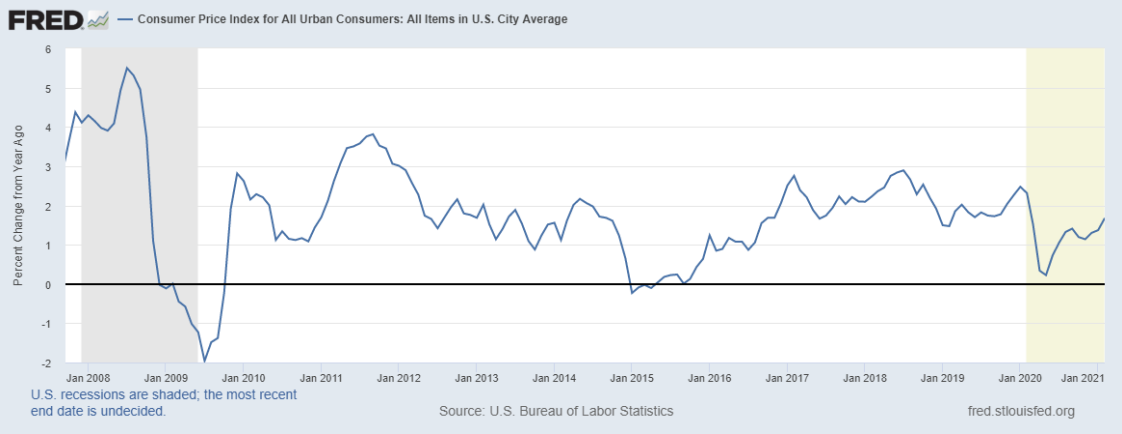
When we talk about inflation or attempt to define inflation, we are really just talking about changes in prices. Inflation is a sustained increase in prices (for goods or services) over some period of time. Inflation typically occurs when demand (for goods or services) grows consistently more than supply. Going back to the Great Financial Crisis (“GFC”) in 2008, the Consumer Price Index (“CPI”) has been in a sustained downward trend with brief periods of jumps in inflation but nothing sustainable (As seen in figure 1). So how does the economy consistently generate enough demand to outstrip supply and drive inflation?
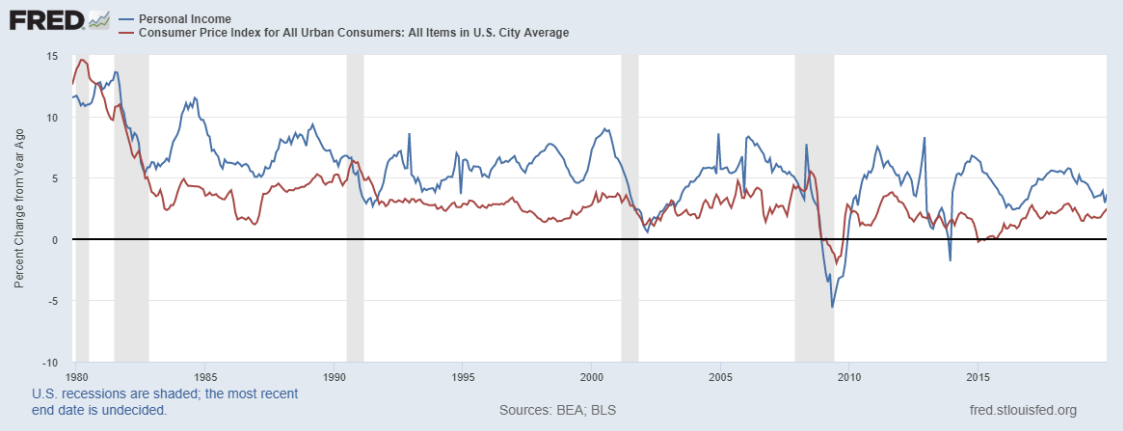
At a high level, numerous complex, dynamic interactions influence the supply/demand balance and spur inflation (or disinflation). Regulation, taxes, demographics, wealth distribution, and technology are all factors at play, but one variable that can capture the lion’s share of the trend is income growth. Notice below (Figure 2) how correlated year-over-year income growth is to year-over-year CPI going back to the 1980s. Income growth has been in a sustained downtrend with CPI, so I believe it is safe to surmise that inflation will remain tame until the economy starts to see real, sustainable growth in income. But it also is more nuanced than this as income distribution also plays a large role.
Income distribution is an interesting topic to touch upon because the newly adopted fiscal policies have really allowed it to flourish. When wealth or income is widely distributed, as it has been with the COVID relief packages, income growth can generate greater demand than income growth that’s more concentrated. This is because higher income households tend to save more money (or put it into the market, etc.), while lower income households are more likely to spend their income (higher propensity to consume). Therefore, a wider income distribution (not concentrated) is also most likely needed to spur any kind of sustainable inflation.
We often hear about how demographics and technology play a role in keeping inflation down. How exactly does that work? Well, it again, ties back into income growth. Demographics can influence inflation because an ageing population is no longer working (retirement) and spends a lot less than younger cohorts. Therefore, as more and more individuals enter retirement it is not surprising to see downward pressure on income growth. Technology also has an outsized impact on inflation because new technology can lower the cost of labor. Lots of ink has been spilled over the years predicting automation in the factories, replacing workers etc. As these trends pick up, less labor force participation will ultimately lead to a slowdown in income growth.
Why Inflation Will Be More Relevant Moving Forward
Production Cost are Set to Rise Globally
The global pandemic has had a significantly negative shock to the service industry because people have been forced to limit interaction. For contact-intensive services (bars or restaurants), it will cost much more due to reduced capacity. Supply chains are also starting to shift and bring back production to the US. This is happening for political reasons but also by the desire to insulate supply chains from any future shocks. This will involve much higher costs as labor is more expensive in developed markets (as opposed to emerging markets). Furthermore, by bringing these jobs back to the US, it will give more negotiating power to the US workers, increasing costs.Central Banks Are Changing Their Playbook and Allowing Inflation to Run Hot
An important development in response to COVID has been Central Banker’s shift in how they deal with inflation. They will now explicitly allow inflation to overshoot their target. The Fed has adopted a new way of looking at inflation; it will attempt to push inflation above its 2% target to make up for past misses. They are referring to this policy as “Average Inflation Targeting.” The Fed is also abandoning old models that linked low unemployment figures with higher levels of inflation. Historically, as unemployment fell, the Fed would attempt to tighten monetary conditions to preemptively combat future inflation (that may or may not have been coming). So, the lack of any “hard” rules makes us believe inflationary pressure will increase, especially at a time when DC has begun to embrace more fiscal policy.
Our Take & Investment Implications
Going back to 2008, policy has been far too restrictive (as evidenced by the lack of inflationary pressure). It has relied solely on monetary policy from the Fed and has lacked any sort of fiscal component. Recall the years following the GFC, our nation (and abroad) was more concerned with austerity measures than growing the economy. This combination of monetary policy and an austerity focus led to lackluster growth in incomes. The stock market did fantastic, but the real economy was not so hot.
However, that mindset is finally starting to change as the Fed has committed to low rates until the economy is back to full employment (as we described above) and DC politicians are finally embracing an expansion of fiscal policy (more spending). That’s why we are starting to see bonds yields go up, signaling an outlook for rising growth and inflation.
When growth is lackluster, as it has been the past decade, investors will pay up for secular growth companies, which aren't directly tied to GDP. That is how you start to get higher valuation multiples for high-growth businesses (Price to Sales Ratios, etc.). With a policy pivot underway from the Fed and from DC, perhaps it doesn’t make as much sense to pay up for those high-growth businesses? Maybe it makes sense to invest in companies that are more tied to GDP growth (cyclicals, asset-heavy business)? As someone smarter than me has once quipped, “The worst thing for growth stocks, is real growth.” While our strategies have not abandoned growth all together, we have been lightening up and leaning towards cyclicals/value since the summer of 2020. We believe inflationary pressures will continue to build at a pace that markets are able to digest.
